
Stalker
Or, When The One With the One Becomes a Rerun

By the time he died, we were friends the way everyone else was, except I had his phone number. I crushed on Chandler Bing, the impish hair model, the funniest of the friends, so effortlessly in the room with you at a perfectly preserved Peter Pan 30-ish in eternal syndication. When I met him in 2017, he was forty-eight and coming down from dentist’s anesthesia. It was dark and the cement was cinematically wet behind MSG where he stood waiting for me, between dumpsters.
“You’re late,” he chided, and I felt his height. He was round, in his face, his hands, his cadence, he was imbued with a roundness that felt worn rather than belonging to him. Chandler plus twenty years of Matthew Perry. I couldn’t not see it, but I also couldn’t not see past it, to what he was supposed to look like. Through the soft slurring was that syntactic crispness, still. A playfully skittish body under twenty years of drug and alcohol abuse that enveloped him like a wool coat.
We met on a dating app. I shouldn’t have even seen him, my “seeking” range cut off at 42, but there he was, and there I was, a swipe of the finger away from a series of act-first-think-laters. But as soon as I could make out his silhouette, I knew I had no business being there. I was a thirty-year-old waif with a high-schooler’s face in a balloon coat I swam in like a toddler at a Rangers game with a fully formed monolith. But I had gone all that way, and I had never seen a hockey game, and how rude, how fucking rude to be a disappointed fan when your role is romantic interest. It was far too sad and too serious and too long a story to reconcile over an ice melee anyhow, and I was there as a plaything, what did it matter. I was never going to see him again. Plus, taking in the real person would require that I see the situation for what it was: aspiring actress desperate for a break appealing to a relic of success whose self-worth was even lower. Low enough to include me. I drank three tequila sodas and drowned out my cognitive dissonance with jokes and questions about hockey, pocketing every laugh I got. And that’s how it went on.
He persisted in calling it a date afterwards, where we texted for an hour before bed. As we critiqued our goodbye—hasty and stumbling and suffused with please like me but please don’t try anything energy—I thought, this is a way through. This feels candid and not like a lie. In fact, given how our relationship proceeded, I think that that very style of talking was the lie we lived in, fabricated vulnerability distracting from the thing we should actually be talking about. What’s wrong with me? What’s wrong with you?
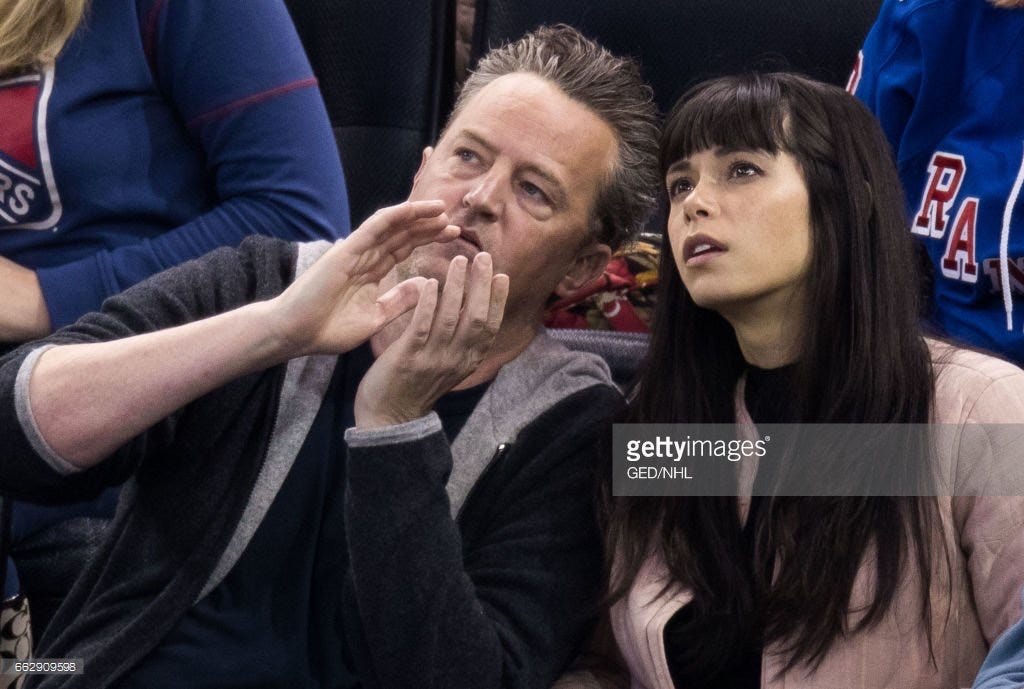
“We are all over the news,” he texted the next morning. This is it, I thought. I’ll never see him again. The shame, to be photographed with me, a photo so widely circulated my mom somehow found it: Matthew Perry and a young nobody who must’ve snuck in, can’t have been there for the right reasons. He followed up with a link to an Instagram video. Him, me, and Carson Daly’s whole family laughing together on the Jumbotron. Fuck. Maybe he doesn’t care?
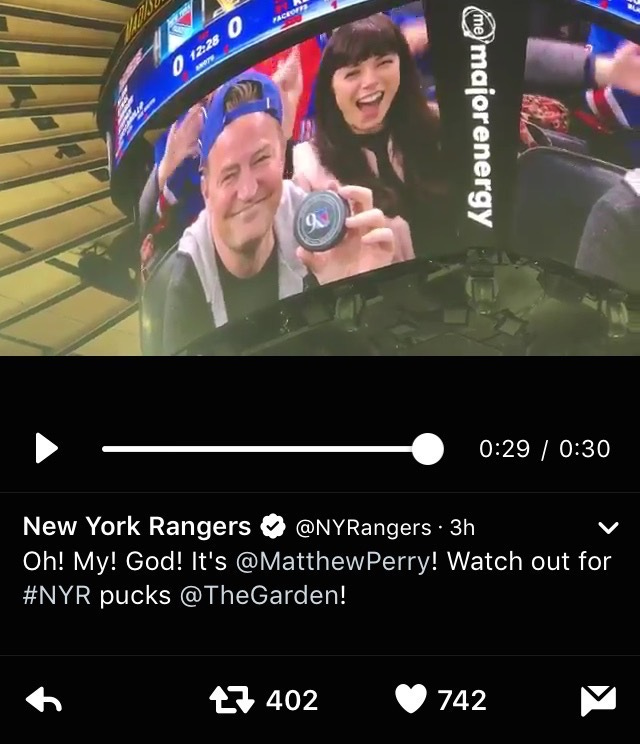
Had he not made and then cancelled a lunch date that day, I probably wouldn’t have seen him again. I would’ve been okay with that. By then I had the validation of a funny guy laughing at my jokes, famous guy approving photos of us in public, nice guy smiling at me and following up at all. It wasn’t as if I thought we would actually date, and I knew I wouldn’t use him to further my career. I’d been in that situation and went out of my way to reject any help, anything that might suggest I hadn’t earned it myself. But I felt shorted now. I’d won another few hours of his company and instead, he got a root canal and went back to LA.
I happened to text him the day he landed back in New York a couple months later and we met up for lunch, where he called me his stalker. I didn’t like that, obviously, but as it went with us, the shtick became a part of our narrative, part flirtation, part pretending to be people we’re not in a situation we’re not. It felt harder to make him laugh than on our first date—not that this was a date. In fact, he prefaced the lunch with a caveat, that he had something to tell me that would change everything. It was an odd midday hour and the restaurant was empty save for us, him with his back to the bar as I sat across from him feeling the empty room behind me, framed as if on the suspended end of a seesaw. The table was both too long and too low and I couldn’t cross my legs but kept trying anyway, the light of day straining through one high window to my left making my eyes itch. He had a messy romantic thing going on in LA, he explained, lives ruined, and, sorry to say, Mitz, but a sexual relationship between us is impossible now. My shoulders relaxed; I hoped it didn’t show. It’s fine, it’s fine, I must’ve said, because it was fantastic. He must’ve known I never wanted that in the first place—not that I was allowed to say it aloud. Not that we wouldn’t go on innuendo-ing afterwards as if trapped in some kind of forbidden love paradox.
I spent the night with him that night. Naturally. Platonically. When I awoke the next day, unnaturally early, I sat by the window willing time to pass, unnerved by the openness of the cityscape. We were toward the top of a building too tall and too far south on the island of Manhattan, the room itself too big for how little was in it, too much negative space, an encumbering sweep of negative space. Eventually, perhaps minutes, perhaps hours from now, he would wake up and find me here, perched on the sill, my head turning to meet his entrance silhouetted by a wild sunrise in a sort of Natalie Portman in Closer portrait. Exploited or exploiting, could be either. Could be both. Or I could leave, leave him his empty box, and he might feel the gravitational pull of my body departing and miss it.
I’ve always stayed too long. All men are my father, and the greatest men—by which I mean not great attributes but great power, prestige, intelligence, stoniness—hold the greatest power to abolish the wound of not-enoughness I carry into every relationship. I can know intellectually when I’m lying to myself, but the drive to rewrite the story of me and my dad and my worth is the rest of my body, the thesis of the work of my entire nervous system. Only if he likes you will you matter.
Two weeks before I met Matthew, my boyfriend kissed me goodbye at the precipice of his hotel room with a body so stiff and cold I felt thrown out. The week I met Matthew, my boyfriend hadn’t responded to texts or answered my calls for ten days, at the end of which I was so riled up, so hot with righteous indignation, that I phone-bombed him and forced him to break up with me as he asked to talk about it later in his I’m-at-a-really-fun-dinner-with-people-I-really-want-to-impress voice, completely oblivious to the option of choosing to leave myself. That’s not how the story goes. That’s not how abandonment works.
I stayed. When Matty woke up, I’d been on the couch for twenty minutes, at least, basically floating above the cushions, out-of-body nervous. “You can do whatever you want, Mitz,” he said, responding to whether I should have stayed or left without saying goodbye, whether I should continue to stay or go home. I went home. The territory of stay and find out felt too foreign and dangerous for how early it was in the day, for how much space needed to be filled from me to where he stood, still half-obscured in the hallway, and as optics-conscious as I was then, I knew there would be less to regret by leaving. Fewer opportunities to embarrass myself, less of a chance he might look at me from the wrong angle and see me. A month went by as I dated around, liberally but in earnest, finding mostly placeholders and one very obvious and very bad Daddy situation. And then, to my shock, Matty texted. “How’ve you been, stranger? Other than missing me terribly?”
What ensued was a sloppy few months of casual meals and chaste sleepovers in New York and LA that I’ll never fully understand but felt as simple as two sad, hurt people offering each other distraction from pain. Exploited, exploiting—if it’s consensual, is it either? It was fun. It was so fun, what a playmate. What an honor?! I thought it might last forever. It was strange, of course it was strange, Mr. Big and Lil Big Ears, but in my logical, from-this-earth, of-this-earth mind, I thought that what we had might be so weird it’s special. That by breaking so many rules of propriety we could inspire the scientists back to their labs, what beautiful law of human nature do we not understand? Like an elephant and a mouse becoming friends. And he was dating otherwise, too, we would dish, so as abandonment wounds go, it was a pretty great arrangement—being in a non-relationship meant never having to break up. Being in a non-relationship meant he may very well have had deep feelings for me that were simply irrelevant, as I might have had him. It was possible.
The part I always forget is that he was a serious alcoholic and drug abuser. He had twenty years on me that he spent indulging and another thirty in and out of rehab. In my memory he’s mostly in bed, head propped on four or five pillows, cigarette in his mouth, saying no one would be surprised if he died. Never a joke, he meant it. He wasn’t saying no one cares about him, or that his life doesn’t mean anything, he knew he mattered to a lot of people. He was saying that the wall that separates us living from death is veil thin for him, he’s been pressed up against it for so long. And then I’d notice the slur, the slouch, the long face. Right. But it was too big. Engaging with it felt intrusive. He was also sober then, still active, wittier than someone in that precarity had any right to be, so it felt fair to laugh it off. And he let me.
In 2018, we’d gone months without talking when I checked his Twitter and saw “Three months in a hospital bed. Check.” It was actually two weeks in a coma and five months in the hospital, I learned, in a rare phone call as I wandered around a tanning booth of a discount store basement in midtown after a bad audition. He recounted that his insides came out of his body like he was a sausage stuffing machine. Completely randomly, one day, fine, and then links spilling out. Not an ounce of worry or surprise in his tone. Cavalier, as ever.
Right.
The last time I saw him, in 2017, he was with his sober sponsee and I was drinking rosé with my now-sober friend on the rooftop of his apartment building. The wine was his idea, as were the bottles of fernet he’d have waiting for me whenever I came over, after the first time I asked for fernet, fernet being the least liquor-y of the liquors—medicine, basically. It was an unremarkable afternoon in West LA, mid-July, an umbrella of sunshine overhead with no direct source soaking into earth-colored building after earth-colored building. I was late, per my reputation, and hungry when I started drinking, so I got dizzy, sunburnt drunk. Will you be okay?, he kept asking. He had to go to his parents’ for dinner, and I had driven. Yeah yeah yeah yeah, I said, insistent, holding the backs of my hands to my face to cool the flush, making no space for irresponsible drunkenness in front of two recovering alcoholics. You can’t drive like this, he said, and he invited me to his parents’ house with him. By then, we were fairly established friends (except not, because what friends text like they’re dating, have three sleepovers in one week and fixate on how they should be having sex but despite ample opportunity kiss only once, barely, awkwardly), and I didn’t care that he was Matthew Perry anymore, had stopped asking why in order to keep saying yes to him and the disorientation.
His parents would come up in the way parents eventually do. This is how they hurt me. This is how the guilt I feel for holding it against them manifests. I knew Matty had the double-edged look what I can do / I’ll show you determination stemming from his relationship with his father (just like I did), and that his mother loved a bit too much (as did mine). I’d met them only briefly, about a month before, side stage after a matinee of Matty’s play in New York, where I was in a gaggle, me and three girls from my acting class, all of us fun conversationalists, engaging even, but young, two younger than me, and smaller, fangirls, footnotes, what else. I gave Matty one last chance to change his mind about bringing me into his parents’ home as we walked the half-block toward the house from his car, we were in a sidewalked suburb after all, I could go for a stroll, you could call me when you’re done.
Matty’s dad swept in and hugged me as I entered. He remembered me. I was shocked. In his dense and otherwise distinguished catalog of people, he had dedicated a space for my face and name, as if I might deserve referencing again. Matty’s mom emerged from the kitchen asking about hunger levels as the boys turned their attention to a small TV in the corner playing the US Open, the point of us being here, the most normal thing in the world. They were tennis people, the Perrys, grew up playing together, father and son, and I was just getting into it. Matty and I would play eventually. He wanted to see me in the outfit. I sat down in a cushioned chair a little behind but next to Matthew that looked like it might rock but only swiveled, and only with effort, feeling thrown by the frictionless-ness of my presence there. I had a vegetable tray on my lap I couldn’t get rid of, having been handed it as the vegetarian, having no space to put it on the coffee table in front of me, and the longer I sat there, fielding questions from the parents, where’d you grow up, how was that, the more I felt like a doll in a dollhouse. The house we were in was homey and modest and paid for by Matthew, a large, implacable asterisk, and I felt like another doll in it, there unnaturally, there by a series of accidents.
Between matches, we took a trip to Baskin Robbins. The banana splits are out of this world, they insisted. Matty drove and I sat in the back with his mom, not unlike my mom, cute, small, smiley. Not unlike me. When we arrived, the woman scooping recognized us, not as celebrity and co. but as regulars, and I was quickly “Matty’s friend.” The whole family watched as I took my first bite in the parking lot, my first ever Baskin Robbins banana split, and when we hopped into the car I shut it away in its little plastic container, not wanting to drop any on Matty’s new leather seats, not wanting be looked at too much. I felt like a toddler, like they must be thinking, what troop did you recruit this girl out of. We hung around the house just long enough for me to get sober and grounded-rather-than-unhinged charming, and as Matty and I prepared to leave, the sun dipping behind the back fence, I found myself admiring a bowl on the rear windowsill, clearly handmade. “I did that,” Dad said, now standing at my side. My dad’s into pottery, too, I thought to say, but I couldn’t seem to hold him in my mind. My dad didn’t live in this world. In age, could be his son. Your son was becoming an international superstar when I got second place in the Toro Park Elementary School spelling bee after missing the word “receipt,” which is still toward the top of my list of accomplishments. “It’s beautiful,” is all I said. And then he gave it to me.
When we got back to my car, Matty was too tired for a sleepover. Too tired to sleep. I drove home berating myself and my body for getting unforgivably drunk on one glass of wine, as if that was the problem. If we were just friends, that wouldn’t have mattered. But we weren’t just friends. I don’t know what we were, but we weren’t friends, or anything, after that.
He claimed, leaving in a typo, that it didn’t bother him. My accidental drunkenness. I’d apologized for it after sending him a gift in the mail, a small, silly, perfect thing, that went days delivered without a word, but in four, “I don’t see anything,” ceased to exist. Whether it had made it or not wasn’t the conversation anymore. He didn’t respond to my text the next day, a link to a story about our celebrity crushes co-starring in a movie, the kind of text that used to whet our swordplay. It felt unfair to call it ghosting. It felt more like the inevitable had finally happened. The elephant had stepped on the mouse.
Whenever a fan approached him on the street, I’d find a shadow to tuck into and watch as they became children again, all ages cowering under the force of his fame, all obliged to look up out of reverence and his sheer height—he really was tall. I would watch Matty for changes, needing his voice to be different. I needed him to be charming and kind and terse so he could come right back to his private life, me, girl who understands and politely waits for her friend to be the guy he has to be to the world and then, hello, sorry about that, shall we get out of here? And I’d come back with a retort, a little sharpness, I’m different, see, you’re not holy to me. The Jackie to his Jack. Marilyn on a good day. But he must’ve smelled it. I couldn’t have been the first. The world was replete with young and dumb emotional beards—show me one pretty girl who doesn’t think she’s special. Besides, what alternative did he have? A guy that famous with baggage so heavy it would implode when touched? What chance did he have of meeting someone who wouldn’t treat him like Matthew Perry?
“How’s your high school coming-of-age script maturing?” I followed up, a last gasp. I didn’t know what I wanted from him at that point, but I knew I didn’t want to be left on read. He replied. “Ha. Hi. How are you?” It felt like a joke, like I was the joke. He went on to say he was staying at a sober living place, that he’d been extremely depressed. For months. About the duration of our friendship, by the sound of it. There was an attempt at the old flirtation from both of us that started from him, surprisingly, piteously. I had been playing tennis, to which he replied, “I bet you looked cute in the outfit.” Flaccid. It was an inconsolable non-dumping, and it felt like his fault. He was the adult, after all. He should’ve sat me down and explained. He should apologize. When he didn’t, it became yet another example of how people are, how men are; they’ll get drunk on your shininess and then, without ceremony, they will take up another drug.
When his memoir came out in 2022, reminders of him and my bacchanal and his abandonment of me were everywhere, nagging me to write him. The end-of-life rally. It was this thing I did when men hurt me, a thing I still do but can recognize I do differently now, because the people I do it with, the relationships in which I do it, are different. Back in 2017, I sent the ex who ghosted me an email that said I was sorry in a dozen different ways, hoisting as much of the blame for our demise onto me as I could in an effort to rob him of full ownership of any negative feelings he might have towards me. “I don’t know if it’s a sign of insecurity or misguided idealism or a pervasive human weakness that only ends once you’ve resigned to death, but I have this image of my future, my ideal future, that I am willing to completely betray myself for to manifest,” it started. “You were god and I was an empty, hungry devotee,” ended the first paragraph of seven. It was dramatic, and he responded saying as much. He also owned up to having a God complex, which felt generous but was too easy to condemn. A God complex?? Accountability no longer mine. Self-reflection no longer necessary. I wrote the same kind of letter when I was (humanely!) dumped at the end of 2018 and was in the midst of a much longer version of it in 2022 with a partner who was yet another step in the right direction, but who regrettably became my wailing wall after my dad’s death and was helplessly trying to decline both roles, wall and dad.
“I don’t kid myself to think that I’ve ever held any kind of meaningful position in your mind,” I began, continuing for three paragraphs of blank, frank honesty. My dad had died, after all. I’d learned apologies are nice but not promised, most effective when the parties have abandoned their motives, and most valuable for their path-clearing properties, where the truth can come out clearer and go down cleaner. “I’ve been self-serving and careless,” I continued, speaking plainly about the big picture, him being who he is, me being who I am, and what that must actually mean. And knowing a response was unlikely, “As long as you are alive to say this to,” I wanted to leave him, “You’re a beautiful, generous person, and I think about you with such fondness, hoping you are alright, laughing, loved.”
Two days later, I woke up to a response. “I was in a very bad way when we met. Very depressed.” Yes, and? I felt myself lash back, but I recognized the voice, the petulance. My motive. “To be completely honest,” his message went on, “I felt a little bit more of a bond with your friend that we met that last day we met up. I just felt more of a contact with your friend.” The directness was stunning, new. The kind of straight-shooting of someone who’s run out of time for bullshit. He said he hoped it wasn’t rude to say, he understood if that made him a jerk. It did, frankly. And it did feel rude, like a jerk-y thing to say. It also, in so precise a way it’s funny if you’re not on the receiving end of it, validated my fears. I’m not pretty enough. Not funny enough. Not shiny enough.
And then he died.
After the briefest flicker of if only I had been there (deluded!! I know), I was irrationally sad. And I felt immense guilt that in the face of every indication he was living on the edge I had denied his struggle. I couldn’t see the depth of it, how wholly that struggle filled his body. In a hot tub after a pickleball game. And in between those layers was a much uglier impulse, a radiant anger. Toward him. I had, after all, apologized for every possible wrongdoing, bared my shame, stretched my generosity, I even responded to his rejection, though it was hard, with all-loving Mother God energy, mustering kindness, permission to leave, “Whatever you need to feel at home in yourself, I support it. Should we never cross paths again, I’ll be rooting for your health and joy in abundance still,” and not only did he not accept or even acknowledge it, but he abandoned me.
Something didn’t feel right. In me. I could tell that somewhere in the chain of guilt-anger-sadness-repeat, the math didn’t add up. I was lying. I didn’t have Matty around to validate my experience anymore, not that he’d ever done a great job of it anyway, perhaps because he never wanted that job, perhaps because it’s impossible. But I had our texts.
I searched my messages for “Perry” and found it smooshed between “Matthew” and “died” in a text to my then-boyfriend, which I couldn’t help but open. I couldn’t help but scroll down, curious, what was my life like in October of 2023. Then-boyfriend and I were engaged, sort of. After my second domestic partner visa denial, I insisted we get married so we could finally live in the same country, I would give up my life in New York to move in with him in Canada, give it an actual go after four years together. He had said okay, which is all one really needs to know—“Shall we get married?” “Okay”—to know it wasn’t what he wanted. Even when, months into our weekly check-ins, a year into hammering myself into a saint he couldn’t say no to, he said he wanted to properly propose, one knee, ring in box, I knew it wasn’t what he wanted, but I let him lie. We were to be city hall official less than a month after “Matthew Perry died,” so the texts just below were all appointments and witnesses and rings and a dress that wouldn’t be too bridal, don’t worry, it’s not a real wedding, and a party because I’ll still have to apply for a visa and will need photographic evidence to prove to the Canadian government that we married for love, which we are, but only on a technicality, yes, I understand the technicality, how could I forget, and the responses would come one word at a time and a day late. I knew he didn’t want to marry me. I thought about ending it but convinced myself it was the weak thing to do. I’d done a lot of internal work by then, therapy, couple’s therapy, somatic therapy, I’d even read a book called How to Be an Adult in Relationships I found in a sublet that I couldn’t shut up about, and it did, it made me way more of an adult in my relationship, it was by far the most communicative and mature and loving relationship I had ever been in. Still, at the end, while the tip of the iceberg was have faith, believe him, the underwater majority was, to quote my younger self, make him end it.
Even in the best of relationships with the clearest of intentions, one’s understanding of the invisible, intangible space between two people is a collection of choice minutiae, compacted, distorted, regurgitated. Even in the most communicative of relationships, there is the issue of two distinct brains, two distinct nervous systems, two sets of subconscious fears and desires and nuance redirecting every impulse by one degree. We all want to have our subjective realities mirrored back at us, but the illogic is in the language. It’s not possible, no two people will ever interpret a text the same way, much less years of amorphous coexistence, much less pseudo-trysts between an irreverent mouse and an armored elephant. Whatever Matty’s feelings were, they began with “To be completely honest,” and, though it hurt, I wouldn’t have listened if it hadn’t, and, a more horrifying thought, I might still be lying to myself to make my logic fit had he survived.
From the day Matty and I stopped hanging out in 2017 until after his death, I tethered myself to him with my remorse. The deeper the shame, the deeper our connection must be. Ergo, the more substantial I must be, to be so connected to him. Even in my final messages, in which I felt so big and generous, I’d hoped the language would make him sad, make him try to find me again. When he didn’t reply, I let the lonely little loser girl in me still begging to be asked out and admired and held creep out from the shadows and take the hit, and then built another road out of my resentment. It was unconscious, my psyche grasping for a way to fulfill its needs, tend to the wound of not-enoughness, but when he died, my motive had to, too.
I knew before we met, when we met, after we met that what was happening required a pair of heads in the sand. The part of me that did love him, and I did, I still do, have love for him, was so fixated on how he felt about me, and careful about what he saw in an effort to control those feelings, that it circumvented the connection I was doing all that trying to find. It’s just as likely that my guardedness is what made it work at all, and it was the love I let slip that turned him off. I don’t know what Matty thought though. I don’t know how he felt. I can’t speak for him, nor can he. The best I can do is try to be honest. The first time I wrote this all out, a finished version of it, I put flowers on things that sit unadorned now, and I think that’s good. It’s also less important to me now than it was then, what he might’ve thought about me, because I like myself either way.
Before my dad died, the impossible happened: I got an apology. Several, actually. And by the time he was ready to be honest, my desire to know him finally outweighed my need to be loved by him. I surprised myself by how pliant my conception of him could be, the Dad-shaped mass in my brain morphed into something foreign and extraordinary. It turned out he was a lot of things I didn’t want him to be. Namely, he wasn’t an idea anymore, and he wasn’t a function—he was a person. It almost made it easy to let go of my “fiancé” when he called it off, on the morning of the city hall appointment I had cancelled a few days before. So I’d been lying to myself about who he was. Lying about what I wanted, too. We still loved the new versions of each other we met as we broke up the best we could. And then I met my boyfriend, my now-boyfriend, a few months later, two years ago today, in fact, and maybe I’d finally forced enough, settled enough, scapegoated enough, lost enough that I was ready to be honest and so, lucky me, was he, and I knew it and wanted it when I saw it. It was extraordinarily easy. It is extraordinary. I look at him, he looks at me. Most of the time, it’s more than enough.
To be completely honest, I prefer the Friends reunion to the reruns now. It feels really unfair that we would trap a human like that, at their hottest, to perpetuate throughout the world like cheap amber. God, I hope we can change. I hope we have the capacity to allow others to change, too, are offered the opportunities to watch the people we love change in real time. So we’ve lived life. So we’ve let it affect us. If you really care about someone, if you’re willing to see what’s actually there, your capacity to withstand imperfection and the discomfort that comes with it will grow. Who knows what will follow; I’m still new to this. But I think we all have some sense that that’s where the good stuff is. Even me, then, peak princess mode, self-preservational and performative, I betrayed myself with curiosity, knew it was more interesting to let be and be uncomfortable than make be and know nothing. Matthew at forty-eight was resigned and tired, pensive, stubborn, he bristled unexpectedly and loved movies he shouldn’t. Whether he loved or just stood me is of little consequence; he didn’t love me how I wanted him to, and that’s okay. He was still kind, so warm, and so incredibly funny. It’s all worth celebrating.
Sometimes, when my relationship feels less easy, I’ll think about my boyfriend dying. It sounds mean or if not mean masochistic, but I’ll think about him dying just enough to build up a big appetite, to stretch beyond my day-to-day capacity to see him, and without fail I’ll wake up out of this debilitating demand for him to love me, love me more, love me better—Right.—and I will set my motives aside and cannot be disappointed. I just think, how lucky am I to get to see a real human today. How lucky I am that I don’t even have to think about what my face is doing while I watch. Let him see. What’s so scary about that.
What a complex and interesting story about self-loathing and love and relationships. So glad I stumbled upon it and even happier you wrote it.
This was such a compelling read start to finish. Thank you for sharing and, more importantly, being vulnerable. I saw so much of myself and my own tendencies reflected to me in your writing, despite different lived experiences here. The passage about the end of life rally, in particular. Wooooof. I’ve never read someone describe that so perfectly and it feels nice to be seen. Thank you for sharing.