Talk D'arty to Me
Or, What to Give the Person Who Knows Everything, When that Person is You

I recently interviewed my boyfriend about his new EP, released May 29th, his mom’s birthday, called Almost OK, on his suggestion. A generosity, maybe, but - and I care when suggestions are acts of kindness and not earned privileges - I knew it would be fun, so I didn’t travel too far down the road of why-is-he-asking-me and just said, yeah, spiking my non-existent microphone every time he brought it up, YEAH. Yeah! until we did it. I gave him two outs the day of and set up my computer and mom’s retired iPhone, tested the audio options until I found something good-enough, and we got to talk in a strange new way that let him be the pearl and me the coarse and salty tongue testing its weight, enhancing its shine. His name is John. Johnny to most. Or to his parents and closest friends, at least. I call him babe, sweetheart, my lo-o-ove. And John. In the transcript below, he’s J, which I’ve never once called him. Wouldn’t dare. Not appropriate, except for efficiency in reading. I’m M. Mitzi. I get called M sometimes, because of my favorite hat, which has an M on it for Moon.
M: Okay, it’s recording.
J: Cool.
M: Is it strange to see me in this capacity, John?
J: It is, yeah / a little bit.
Like a play, we talk over each other a lot - but not strategically. And when we do, a slash indicates when one speaker talks over another. In this case, I cut John off between “yeah” and “a little bit” - though I didn’t mean to.
M: (in my Paul McCartney voice) John.
And anything italicized that is also parenthetically held describes the delivery of the line that follows.
J: (in his imitating me imitating Paul McCartney voice) John.
His is way better.
M: This is going really well. Do you feel nervous?
J: A little, yeah -
M: Hello world. I have here today my very (searching for the one right adjective) handsome boyfriend, John Gallagher, Jr.
Johnny laughs after “handsome,” because he is modest, though I believe he believes himself to be good-looking.
J: Hey, how’s it going? It’s great to be here, at home, with you.
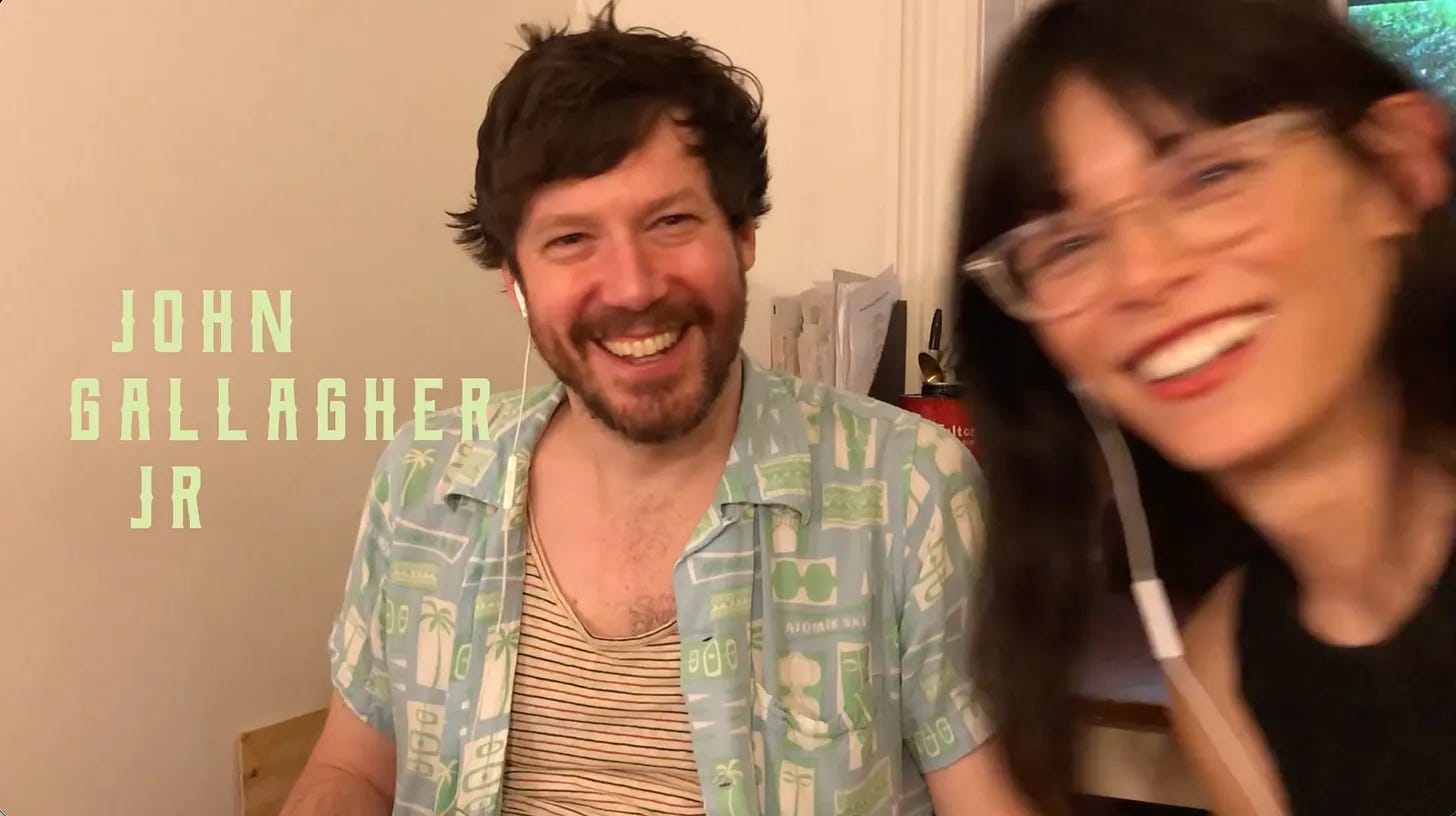
We are in his office, which used to be our bedroom, but got switched into his office after I moved in because for almost a decade it was the bedroom he shared with another woman, which is fine with me, live life, you know, but altering the juju seemed a practical thing to do.
M: What are you drinking?
J: Uh, oh, I, well, I went, uh, to several grocery stores just to procure Garage -
M: Are your hands shaking?
J: Yeah, I’m nervous. That’s the DT.
M: What’s DT?
J: The tremors. Delirium Tremens. / This is my first -
M: Oh, I lo-o-ove that beer.
J: It’s a great beer. I discovered -
M: Also, this is not gonna go on / I’m gonna cut this out.
We’d actually gone on much longer than what you see when I mentioned excising this back-and-forth from the interview, but I thought, good opportunity to show some Johnny charm, show how we back-and-forth, let ‘em have a little.
J: - them through a friend when I was living in Upper Upper West Side / on 99th Street.
M: With your mom?
We will learn that I will rarely - I do rarely - let Johnny finish a sentence. It is a love language, to get to the answer first, but it is not, I am aware, polite, and probably not appropriate behavior for an interview, which is when I decide this is not an Interview, it is a Con-ver-sa-tion.
J: No, when I was 19, I was living with / my friend Aaron Lee Tasjan -
M: Oh. Ahh yes.
J: - and, uh, I went to a place called the Abbey Pub and, uh, I had a couple of Delirium Tremens not realizing how boozy they were.
M: Ohhh, hefty.
J: I went to a rehearsal the next day for the very first workshop I ever did of Spring Awakening and was violently ill in the middle of rehearsal.
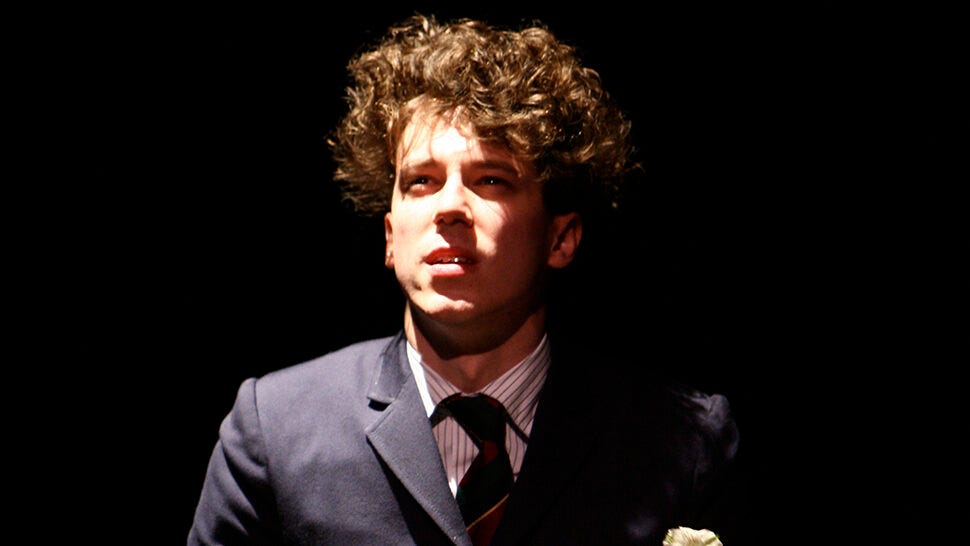
For anyone not yet familiar with the video component of this interview, I need you to know that I supplemented this detail with a photo from the internet of Johnny in his Moritz outfit, the hair and all that, and then quickly cut to another photo the internet supplied of Moritz in a bit of a state, tormented by the looks of it, or impassioned, at least - I don’t know, I haven’t seen the show.
M: What percentage is this?
We’re back to the beer again.
M & J: It’s 4%.
J: It’s lighter than - a Miller Lite is 4.2, which is the same as a Coors Light. Well, uh, Coors Light is 4.2, and Guinness is 4 point. That’s my bread and butter. I don’t really want anything much more / than that.
M: ‘Cause you drink beer to hydrate.
J: Yeah, I wanna drink several.
We spend a lot of time talking about beer. In life -
M: Of course.
J: Y’know, I don’t wanna just have one and be like, ugh, god, that was brutal. / That’s why I can’t get down with the IPAs.
M: I don’t want you to do that either.
J: No, it’s not good for any of us.
- and I feel like, why not give you all a sense of that here.
M: High five.
“Ohhh!” Johnny sings if you’re watching the video, because though this looks like an interview series, minus some of the professionalism and production value, it is in fact a one-off, a special, if you will; this interview series exists solely to interview John Gallagher Jr (whose name you’re now reading if you’re watching the video) for the record from which the “Ohhh” was pulled, specifically chosen as it comes from the chorus of a song named after me - about me, even - “Mitsuko” - the penultimate song on the very album we are sitting down to talk about for its newness to the world (two weeks old!) - and because this is a one-off - sorry, going back, the squirmy TITLE CREDITS -
TALK D’ARTY TO ME
- are for him - about him, even - though, who knows, maybe I’m great at this, and if I do conduct another interview, well, I’ll wanna talk d’arty to them, too, I bet. I wanna talk d’arty to everyone.
J: (checking in on the hand jitters) Let’s see, how am I doing.
Oh yeah, and I’m your host, Mitzi Akaha.
M: Okay, so -
J: Let’s get down to brass tacks.
M: It’s funny because I know you so well, and I thought, I’m not gonna have any questions, I feel like I know everything, but there’s a lot that I don’t know.
J: Well, it’s funny / being in a relationship and you live together -
M: Just that, you take it for granted.
J: I feel like your day to day starts to be like, Did you sleep okay? Are you hungry? Are you tired? What’s up? Why are you upset? You’re mad at me? We wouldn’t sit down like this otherwise. And you wouldn’t, like -
M: Facing one direction.
J: - put it - you wouldn’t, write out a series of questions to ask -
M: That’s true.
J: - until now.
M: These deep conversations are usually just like, What have I done wrong? I’m sorry.
J: Sure.
M: Please cuddle me. Okay, so my first question,
Q1: When did you decide that you had a voice worth listening to? I know that you were born into a musical family (Johnny takes a pull of his Garage Beer, waiting for me to finish) but when did you first hear your own voice and think other people care to hear this? ‘Cause I sing, but I just know deep down, no one wants to hear this.
J: I still, y’know, I mean, to be totally honest with you, I still don’t think I have a voice worth listening to. I mean, I like to sing -
M: You like to sing.
I can’t help but interject here with an audio clip from a 1936 Merrie Melodies cartoon called “I Love to Singa,” in which a jazzy owlet by the name of Owl Jolson betrays his family’s classical music style to enter a radio amateur contest with his entry of the same name and wins, forcing his cantor parents to accept his differences; the cartoon has taken on another life within the couple’s shared mythology.
J: (acknowledging the reference) Uh, I like to singa.
M: You like to singa.
J: (accompanied by the audio clip now) I like to singa. (And back to the timeline) But I still really struggle with the sound of my own voice. I think we - a lot of people that I know do. You listen to, you know, a recording back and you’re like, that can’t be, that’s not what I sound like / because there’s a dissonance.
M: Do you like how you sound in your head?
J: Um, more or less. I’m sort of, I’ve made peace with it. I’ve gotten more comfortable. The first few times that I listened to my recorded voice, I didn’t enjoy it. And it really took making more records. I think just getting more comfortable being in the studio and recording. And, and sort of knowing that there’s gonna be a disconnect between what I hear while I’m singing, what I hear when I’m in a vocal booth, what I hear when I’m on stage, and then what I hear back at me, you know, out of two speakers. But I’ve reached a pretty comfortable place these days where there’s a lot of other singers I’d rather listen to. But I’ve made peace with / sort of thinking -
M: That’s healthy.
J: - I like the way I sing. It’s sort of developed through time. It definitely got stronger. I used to lose my voice a lot in the early days when I was playing in bands because I really didn’t have any vocal technique. I liked writing songs. I liked singing.
OWL JOLSON: I like to singa!
J: It didn’t really matter to me as much in the early days what people would think about my voice. I sort of knew it wasn’t perfect. I knew it was sort of rough around the edges. And especially when I sort of tripped and fell into doing musical theater -
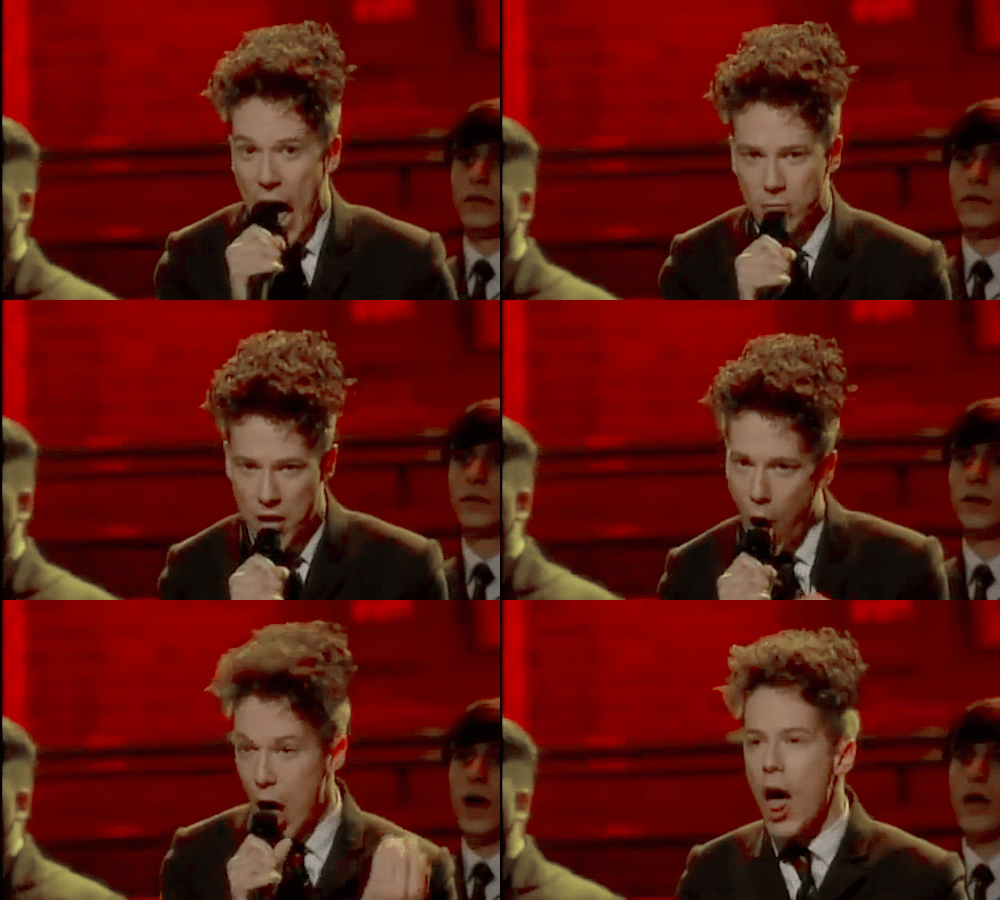
I found this great GIF of Johnny as Moritz in Spring Awakening doing a kind of barfing gesture into a microphone, hoping it’ll get a laugh.
J: - in, you know, 2005, 2006, I really wasn’t trying to do musical theater specifically because I knew I didn’t have like a powerhouse voice and was very self conscious about it. But, you know, I grew up listening to a lot of rock-and-roll records / and folk records.
M: Did you try to develop that voice? The Broadway (cover your ears, ‘cause I’m gonna) BROADWAY BELT -
and bring back that hilarious GIF of Johnny gagging over a mic.
M: Aaaaaaaaaaaaah!
J: No, it’s never. It - it just didn’t come natural, and felt -
M: You didn’t wanna push it.
J: If I had to push it, then I knew it would be something that I was like, entirely fabricating. And then I just sort of knew like, instinctively that I was like, well, that’s not gonna be organic. And that won’t be me.
M: I guess it’s the same thing, you never wanna feel like you have to force a character. If it doesn’t come naturally, you just sort of accept that that’s not within my ability and let it go. Or / do you -
J: Yeah I mean, I do think obviously pushing yourself can be a pretty transcendent experience, but I think there is something to be said for just whatever catches the most current. Like if you feel pulled in a direction or if something sort of comes more naturally to you, I think that’s usually sort of - the first instinct is worth listening to. Sort of like, well, what’s the best idea? What’s the easiest - not that you wanna take the path of least resistance, but you / you gravitate toward something -
M: But like what are -
J: - for a reason.
M: Right, what are my unique contributions and just being happy with that.
J: Mhm.
M: I struggle with that a lot.
Johnny smiles, smug, like, I never struggle with that.
M: All right. We’re moving on.
Q2: You’re an incredibly candid person.
J: I don’t know if I answered that last / question. Now that I’m thinking about it.
M: Oh, did you not answer? Oh, what came first? The / the need -
J: When did I -
M: - to write music or the need to perform?
J: Probably perform. You know -
M: Okay.
J: - when you’re a kid, you’re just sort of a ham, and you just wanna get up and be seen. But by high school, I knew I wanted to write songs.
M: Right, You’re / self-taught -
J: Like a songwriter. I took guitar lessons when I was in the fifth grade, but I sort of gave it up because I was, I - it wasn’t coming quickly and I was very impatient. But then when I was about 14 -
M: I can’t imagine.
J: I started teaching myself. I got a book of chords that somebody had given me and took my sister’s Guild, which is right there behind you as a matter of fact.
Johnny indicates behind me, to a guitar neck positioned so it looks like it’s been jutting out of my shoulder this whole time, like, that, that thing you’re blocking, only my oldest friend in the world?
M: Oh, that’s still the one.
J: Yeah, that was my sister, Jo -
Why don’t we see this thing home and overdub Shania mouthing “Still the One” from the ninetiesest ‘90s music video while I sing the refrain -
M: Still the one!
J: (probably thrown off) Joni. This was my sister Joni’s guitar, but that - she learned playing guitar on that guitar and then I sort of stole it -
M: Gotcha.
J: - in high school, and I’ve been taking care of it ever since. But yeah, I started writing and learning chords on that. And I think like, once I was in my early 20s, to, to go back, circle back and answer your question, I think that’s when / I started -
M: This is the first question of, like, ten.
J: I know. that’s when I sort of realized, like -
M: That’s cool.
J: - a big part of it was getting Spring Awakening. Like -
M: Mmm.
J: - that was very validating -
M: Yeah, totally.
J: - that, that it was like, well, these people could have, like, anyone singing in this show. They could have a Broadway star, somebody that can really belt. They have chosen somebody sort of unpolished and rough around the edges. And my voice was not sounding great in those early recordings. But they value the character and the passion over sort of, you know, uh, perfection. So that’s when it - that sort of gave me the confidence to be like, I’m gonna start writing more. And then I started playing with this band, Old Springs Pike, that I was in, which is full of my, my high school friends. And playing live in that band was probably the first time that I really started to feel genuinely, like, confident. Like, 19, 20, 21, 22. I was playing out a lot live, I was playing with the band. Got cast in a show that went to Broadway. So it was a very sort of, um, encouraging experience.
M: I can’t imagine there being anything more validating than starting a band with your friends and being elected a singer. That must mean my voice / must not suck that much.
J: I can’t be - it can’t be terrible. Yeah, it can’t be that bad.
M: Maybe that’s what I should do. My mom still, and you’ve been there when she’s brought it up, loves to remind me that I tried to teach myself guitar in high school. And I, like, physically, I broke it.
J: Broke the guitar.
M: Yeah.
J: On purpose?
M: Absolutely not. I was dancing to Finch. Remember that band?
J: Sure / “What It is to Burn?”
M: With my friend Carrie - Yes!
J: Was that the song?
M: That was the song that we were / listening to, in fact. I remember just stomping my foot -
J: I remember them singing that on Conan O’Brien.
M: - right on the neck of the guitar. And I / thought -
J: That’s hardcore.
M: - my gift to the world is to never touch a guitar again except to deliver the broken one back to my mother and apologize. Perhaps the first apology I ever gave my mother.
Is he listening to me? Did he get the memo I transmitted to him about this not being an Interview but a Con-ver-sa-tion? Or is this just how people talk? I do love Conan O’Brian, like, unhealthily - maybe that was for me?
Q2: You’re an incredibly candid person. And as far as I know from what you’ve told me, you’ve always been that way, with your parents - like, the things that you tell me you’ve told your mom when you were very young - really remarkable. What was my question? Oh, yeah. You’re also so publicly vulnerable, which I think is what makes you such a beautiful actor. There’s just a wall that you seem to not have that so many others do have. And I wonder, in your musical life, if there’s perhaps a channel that’s not open in your personal relationships, your relationship with your therapist even, or in acting, that music fulfills for you?
J: Yeah, I, I, absolutely, I think so. I get to sort of through songwriting, and I think one of the magic elements of it is that, yeah, you do get to choose how open, how raw, how real, how honest am I gonna be. And in doing so, what do I wanna talk about? Is it about me directly, is it about something that I see in the world, is it about something that a friend is going through? Yeah. I sort of hold myself to a bit of a standard, and I’ve always been this way, even when I was a teenager. I just knew that I wanted them to cut through. I wanted them to resonate with people. I wanted people to have those aha moments where you go, oh my god. I know that. I know that feeling. Because that was always sort of the, you know, that was a big early Eureka moment for me listening to music, was that I was drawn in by confessional singer-songwriters. I remember I was in the fifth grade when my mom played me Jackson Browne’s first record for the first time. And you know -
Jackson Browne’s almost-immediately-tear-jerking “A Child in These Hills” fills the background.
J: - I, I was like, what is this? This man is like -
M: Mhm.
I wish I could play the whole album in five seconds so you could know what he’s talking about, but having to endure art from beginning to end is unfortunately required to gain an understanding of it, of yourself, of -
J: It’s a rock-and-roll record, but it’s acoustic guitars and harmonies. And he’s singing about, like, a friend who died, he’s singing about a lover leaving him, but it wasn’t overtly sort of precious or saccharine. I owe a lot to my parents because I saw what worked on them. And I could see my mom, how moved she was by this music. I remember thinking, Gosh, man, I would love to have somebody be driving along one night, listening to one of my songs and going, Oh, I know what he’s talking about.
Is it you? Are you that person?
J: That’s fueled me ever since. If I’m being real and honest about my experience, I think that, that, that will land with somebody out there.
M: Do you approach your acting that way too? Does that / cross your mind?
J: Yeah, I think so. Well, I just think - I know that there is, like, a lot of schools of thought with acting. And I think we live in an era where it’s way cooler to be strange.
M: Yeah.
J: Like, I feel like we equate odd performances with being like, Oh, that was really good. And other people are like, Wasn’t that weird what he did? I loved it. And that’s all well and good. And I think, like, you can get to some really sublime, interesting truths by being absurdist or sort of trying a sort of really, uh, left of center approach to material. But whatever I’m doing, whether it’s with my music or with acting, I’m like - I think, first and foremost, yeah, I want somebody to watch that and be like, I believe they’re going through that. I believe they mean -
M: Mhm.
J: - I think they mean that. But I think it’ll probably mean something to somebody else because they’ll believe it and sort of, you know -
How long I have sat, not talking. Could it be growth? And, proof.
M: Yeah.
J: - internalize that.
M: It’s still amazing to me how you seemed to avoid developing this sort of hipster mentality. I don’t know if you went through a phase like that when you were in high school? When you’re younger, it’s not cool to care about anything.
J: Yeah. I think, I think it really - I have two sisters and / I’ve always been -
M: I just find -
J: - so close with my mom. And then -
M: Did you ever go through that phase though? Of like, nah, fuck this thing, it’s lame.
J: Oh, / absolu-u-utely.
M: I don’t care, even, especially when you care.
J: Yeah.
M: You did.
J: And I mean, I think I still sort of struggle -
M: Oh, do you?
J: - because I, well, you sort of see in the music world, and in acting, I feel like a lot of people that sort of trend upward are aloof. It is still very cool to act like you don’t care. And I, I’ve always sort of felt like, Am I - should I not? Should I - am I trying too hard? Should I have more apathy? And then I have to sort of block all that out and just be like, what do you - what do you believe? What do you feel? What do you wanna do? What’s real, what matters to you? I remember when, I mean, I moved here when I was 18 in 2002 and the first ever hipster that I, / that I met -
M: Ohh, yeah.
J: - and sort of realizing, Oh, all the stuff that I like is not seen as cool here. What am I gonna do? And I think I just sort of waited everything out and realized, oh, these cycles are gonna sort of go through and the trends are gonna / sort of rise and fall.
M: Yeah, it’s definitely come around a bit.
J: But yeah, I’m lucky. I’ve always been really close to my mom and my two sisters and then my dad really mercifully - I mean, sports, toxic masculinity, not around in my house growing up. And I don’t know what I would have done if that had been something / that I would have had to contend with, you know.
M: Very sweet, soft people.
J: Very sweet, soft people, and, uh, accepting. A lot of acceptance.
M: You’re beautiful and I love you.
J: (meaning it, despite the delivery) I love you, too. You’re very beautiful as well.
Q3: Um. I was wondering if you feel like you can recognize a persona in your music when you’re writing or when you’re on stage, or maybe even a per song thing?
J: Yeah, yeah, I think so. That’s, that’s interesting. I mean, I, I think there is like an inner Charlie Brown that I have that I think is sort of in / a lot of my songs -
M: I see that.
J: - that, you know, is sort of running to kick the football and, only to have it yanked out from under him and fall on his back. Like I, like, there’s sort of an underdog mentality that is sort of my everyday approach.
M: That’s funny, I feel like watching Charlie Brown Christmas (as if that is the actual title?? What a difference an A makes?!) was akin to watching, like, a Gallagher home video.
J: Sure. When I think of like, “Back in Berkeley,” “Instagram Crush” or the narrator of “Tough Spit,” and even in “Never Leave,” which is a finger-picked sort of ballad, but - there’s an underdog. There’s a person that is sort of struggling to do the right thing, say the right thing, be the right person, love the right way, live the right way and, and is sort of tripping and falling throughout. But that’s like - that’s integral. It’s so sort of center to the journey. It’s, it’s so not interesting to hear sort of a song about somebody that’s like, I did everything right and I’m having the best time.
M: I’m almost envious that you have a character telling the story that’s specific. When I’m writing it’s sort of a cloud mess of thought like, oh, that, that one.
J: Mhm.
M: Okay, let’s look at that. Huh. Let’s analyze that.
J: I relate to that, I - / I -
M: Yeah?
J: - feel similarly like, uh, yeah, I don’t always sort of set out and think, like, here’s what I’m gonna write about, and here’s, you know, the perspective that it’s gonna be.
M: But even the identity, I feel a little identity-less, I think, when I start writing stuff.
J: Oh, interesting. Yeah. Well, that must be very freeing. I’ve always been sort of envious of people that can do the storytelling song. Like that can be like -
M: You do the storytelling song.
J: Well, there is, there is storytelling, but - I can put myself in other people’s shoes, but I’m reluctant to speak for anyone but myself. I’ve never really quite felt ready to sort of co-opt it and sort of write from it. I mean, I think that’s -
M: What about fictional characters?
J: Well, that’s - I think that’s why I like writing. Well, I mean, this would be fiction too, but in a way, it even / still feels like -
M: That’s what I’m saying, but you still feel like you’re co-opting, even though it’s fiction?
J: Somehow with songwriting. A little bit. I mean, I definitely have songs that are, where I make it very clear that it’s not, you know, me, Johnny, singing the song. When I started out, I think I, you know, I wrote a lot of songs that were very clearly from the point of view of somebody else. But the last few records, most of the stuff has been very first person. You sort of know, oh, he seems to be singing about something from his life. But I think that’s why I started to write screenplays in the last few years. And I actually really do enjoy having, you know, making a lot of characters talk to each other. But the music, I find it easier to just talk about what I’m living through.
Q4: On the write what you know thing, who’s the, who’s your favorite porn star? Are you ready to share? Is there one specific porn star or is it like an amalgamation of all the porn stars you love?
J: I don’t have a favorite porn star. Um. There’s some incredibly innovative performers in the field. Uh.
M: What does that even mean?!?!?!!!
An honest question.

J: No, I, you know, that, that - that is a lyric from my, the first, first -
His speaking cadence didn’t change so much as the amount our speech overlaps makes it impossible to cut out the hedge words, but he does come across as slightly bashful, doesn’t he? I love this conversational place.
M: Tough Spit! / Yeahhh. Your favorite porn star -
J: Tough Spit. The first single and track one, you know (reciting the lyric in question), your favorite, uh, porn star -
M: (alley-oop) - is far right wing.
J: - is far right wing. I, that lyric, sort of, I mean, I don’t want to blow up anyone’s spot. And that, again, is like, one of those interesting songs where the verse is - I switch, you know, um, point of view in that song verse to chorus. The verses are all, you do this -
M: Yeah.
J: - you do that, you do, you know, uh, tough spit.
He hesitates. Surely he jests?
M: I don’t really wanna get shot.
J: Wait, is it tough… (laughing) I can’t remember my own lyric. / Tough spit you -
M: Tough spit you / hit snooze and slept in past ten.
I have watched him sing this song on stage at least fifteen times already.
J: (trailing behind) - hit snooze. It’s all “you,” right?
M: Yeah.
J: But then the chorus is / I was gonna go to the store but I don’t wanna get shot -
M: (continuing) You woke up on the wrong side of bed again -
J: - so I’m sort of, like -
M: (I know the whole song, muh-fucka) To breaking news, hey, this just in.
J: Man, this just in.
M: Man!
J: Uh, your favorite porn star -
M: Specifically “man.”
J: Uh, but, uh, so I’m, like, imagining talking to like, that, that / third person sort of character.
M: So it’s not your favorite pornstar. It’s your / favorite porn star.
J: It’s not John Gallagher Jr’s, but it’s like, what if, yeah -
M: Imagine / if your favorite pornstar -
J: I think that I was -
M: - did not align with you / politically.
J: I was finding out at that time, it was sort of an era where I feel like learning / that anyone you sort of dug -
M: To discover that -
J: - that might not share your ideology -
M: Right.
J: - whether it was, like, your favorite songwriter or - but I just found the idea sort of funny to find out if there was an adult performer that you were quite fond of, and then you found out that they didn’t / align with you ideologically.
M: I remember - (we will never come back to this part, but it had to do with Arnold Schwarzenegger.)
J: - that, that just cracked me up as a, as something that might dismay you in your day.
M: But is there not something really hot about your favorite porn star not aligning with your politics?
J: I mean yeah, that, I mean that, that you can put that in the lyric as well, that maybe it’s not the worst. It doesn’t have to affect your enjoy - (continuing to dig) I mean, that, right, you set, you separate the, uh, artist from their…
M: We’re drawn to the opposite, foreign thing.
J: Right, / yeah.
M: And getting very close to it.
J: Yeah, you know -
M: Dangerously hot.
J: Yes, right, yeah. Maybe.
M: Maybe.
In the process of transcribing the interview - right now - I realize he has not answered my question. The man I share a bed with has conned me, but perhaps it is better this way.
M: Okay, where are we? Oh, yeah, speaking of, like, the hottest women you could sleep with -
Johnny laughs so uproariously, like, it could be humiliating but it actually feels like love?
M: Before I get into this next question, I wanna pull up something that you said in a recent podcast interview -
J: Oh, I love this.
M: - called RiYL. (With gusto) “But the merciful thing is that I am in a new relationship and incredibly, incredibly smitten, and very happy, and feel very lucky. So, you know, I don’t want anybody to to, to worry about me here. I’ll hopefully land on my feet.” So, it’s actually, it’s not my question. It’s Carson Kelley’s question.
J: Are you, like, sourcing out questions to friends and - ?
M: I was on Marco Polo with him, so I thought, you’re a musician, I don’t know / do you have any -
J: Yeah, I love it.
M: - musicky / questions for Johnny?
J: Oh man.
M: So Carson / Kelley posted this question -
J: The thoughtfulness, Carson.
M: - that’s actually from Almost Famous in response to your new / hit single -
J: Fantastic film.
M: “Mitsuko.”
J: Everybody’s playing it.
M: Everyone. Yeah, it’s, uh, it’s about a supernatural, like, fairy woman who has, like, healing powers. She sounds awesome.
Those watching the video, please don’t tell on me.
Q5: Do you have to be in love to write a love song?
J: Um, I - I mean, I think everything is, I think everything is sort of love and yearning. I really do. Like I - well, have you ever heard of a little song called “I’m Always in Love” by Wilco?
M: Oh yeah.
J: I sort of feel that way / you know, I think like, we all -
M: (singing) I’m always in love!
J: - are always in love, you know, on our worst day and our best day. Like I think we are sort of always in love with something or someone, or in love with the idea of trying to get to another place.
That human sound you hear in the background is cooing. I’m cooing, unconsciously.
J: Like I think that there’s an engine, like love is an engine. It helps if you’re - man, it really does help if you’re over the moon for someone. You can, uh -
This is when I utilize the two cameras and break the wall between our worlds, my head entering his head space, like - hello?
J: (chuckling, oh, the antics, Mitz!) - you can really knock out some fun love songs.
M: (dreamily) Yeah.
J: It’s very, it’s very intoxicating and sort of disruptive, and it’s sort of all you can think about, and therefore it’s all you can write about at the time.
M: Well, also that’s sort of infatuation, ‘cause you’ve also told me you had written songs about me at the very beginning of our relationship. But now that we’ve been dating for over two years, you’re like, I just feel less, you know, compelled to write music about you cause we’re sort of in this cool place.
And it really is cool - I don’t mean it facetiously, even though I want more songs written about me, who wouldn’t.
J: Yeah. I think like there’s, there is like / phase one -
M: But that’s being in love.
J: Phase one. Yeah.
M: We’re in love / now.
J: You think phase one is infatuation. And then -
M: Yeah.
J: Yeah. I mean / that, yeah, there’s some infatuation.
M: Well, it’s a style of loving.
J: Obviously, like those first few months, like you know, your brain, you’re like / you know your receptors are like, on fire.
M: It’s probably harder to write about deep love. There still has to be some kind of / compulsion.
J: I don’t know. Yeah, I, if you’re lucky, you just keep sort of riding the wave and then there will be another batch of songs. There will be more. There will always be more. You know / hopefully.
M: There will always be more.
J: I mean, unless the well runs dry, but god willing, that won’t happen. That’s the well of inspiration for songwriting.
We’re not melting down, we’re pushing through.
Q6: On the note of what compels you to write something, is there a certain feeling or energy that you find the most catalyzing for songwriting / specifically?
J: I mean, I do, you know / like -
M: I have an opinion about this for you.
J: Oh yeah? What were you gonna say?
M: Loss. Since I’ve known you -
J: Yeah.
M: - Goodbye or Something came out and then you were touring with that.
J: Yeah.
M: All the music I was hearing was about a huge loss in your life.
J: Right, yeah.
M: And then of course we had this really fun year, there were a few songs about me. Love love, love. And then another really big loss in your life. And then came more recorded music.
J: Mhm.
M: Coincidence, or…
J: I mean yeah, like you said, I think that is the most / galvanizing thing, yeah -
M: If it’s not love, it’s the opposite.
J: - it’s love and loss. I mean, I don’t - that, I mean, that’s my favorite music to listen to, it’s obviously, like - I think that sort of encompasses all. I think it all sort of is - that, that’s one sort of giant umbrella / life experience.
M: That’s life experience, love and loss.
J: That’s the - that’s the life experience. But I do find it to be, yeah, to be the thing that sort of, I get the most lit up about. You feel excited about something new, or you feel devastated about something that you’ve lost. And those two things, you know, will always make me wanna, wanna reach for a guitar.
M: Yeah, but very live, active feelings in your body as opposed to like a memory.
J: I don’t know / there’s -
M: Although there’s Lido Lane / it’s sort of memory-based and nostalgic.
J: I love - that, that’s the thing, too. Well, I think -
M: On Almost OK, it’s definitely “Never Leave.” The first twenty times I heard it, I cried. And “All this Changing” -
J: Yeah.
M: - which are both sort of a longer span of time. Not such a sharp wound, more of a dull ache.
J: Right, yeah. And I - I was, I think, too, like I, I look forward to reaching back into my past and writing about stuff that I haven’t touched yet and stuff that I haven’t necessarily looked at. I’ve had this feeling sometimes that I think like, well, as I get older, my experiences are gonna change. You know, when you, when you’re younger and you’re sort of throwing everything against the wall, like, when you’re running around in your teens and your twenties, and you’re getting your heart broken, and you’re having like, wild adventures, like, there’s a ton of grist for the mill that you can / gather.
M: Mhm.
J: Um you know, I think, like, I’m in my 40s now, and sometimes I think, like -
M: We’re settled.
J: Oh gosh, like what, what, what’s gonna rock my world, you know, in my 40s? What’s gonna make me wanna write songs?
How lucky we are, to have only to look up to see the resplendent moon.
J: And I, I - I like the idea of going back and -
M: (humbly) Mhm.
J: - and, like, writing about things. It’s funny, “Mitsuko,” which is a song about falling in love with you, just, as it would happen, I don’t even really remember how it happened - when I sat down to write the first verse, it was all about trying out for the drum chair and the jazz band. And that was like the jump - the jumping off point. And I didn’t know where I was going with it. And I just thought, I didn’t make the drum chair at P.S. Dupont. I couldn’t read the music. Mr. Chapman just scoffed. He stuck me on the shaker / the cowbell and the gong -
M: The cowbell and the gong.
J: Which is true. / I couldn’t read the music in the sixth grade, and so I was put into auxiliary percussion -
Garbled ancestral chanting can be heard in the background, using the subsequent lyrical lines of Mitsuko; it is not the volume but the words that hold the power.
M: That’s how I knew my timing would always be off.
J: - and hitting the cowbell.
M: Yeah.
J: And that’s what I had to do, I couldn’t play the drum set. But I really loved writing that verse about sixth grader Johnny. And it made me think, oh, now that I’m older, I really would love to go dig through some journals, and look at pictures, and write some stuff about my / past.
M: Did you keep a journal in sixth grade?
J: Yeah.
M: So cute.
J: Yeah, I have -
M: Can I read it?
J: Sure, it’s not very interesting. I found one in my storage space recently, and it’s mostly like, “I can’t wait to see Independence Day this summer.”
Oh, you!
J: “This morning I had two pieces of toast and some scrambled eggs. Anyway / gotta go to school now.”
M: A food diary!
J: “Hey, sorry. I haven’t” - I, I would apologize to my journal. I’d be like / so sorry -
M: No, it’s amazing. It was a third party entity.
J: But I also really sort of felt like I’m writing for me, but I really hope somebody finds this one day. Early journals -
M: The posthumous -
J: - especially when I was a teenager, I was like, I gotta write these amazing entries. I really wanted the / journals to be like -
M: I mean I, I relate with that. Like, in my adult life.
J: Yeah, I was like, when I die a tragic young death, someone will find these and be like, “He was brilliant!”
M: “He ate eggs and toast! Both! Together! Imagine!”
And we la-a-augh and laugh.
Q7: So, the title of your album. Is “OK” the goal? If you say you’re Almost OK, it makes it sound as if “okay” is sort of the best you can hope for. / Is there beyond OK? Do you aspire to that?
J: Right, right. It’s something that I come back to a lot in that, for many years, I was struggling with a lot of anxiety in my, um, early 30s. And I remember talking to my therapist and being like, I feel like what I really want - I’m visualizing a dial. And it’s like, I’m either all the way down here, or I’m all the way up here. And I remember just being like, I just wanna get here. Like I just wanna be in the middle.
M: Stability, somewhat / or homeostasis.
J: Like vis-, vis- - yeah, just like, visualizing that and that I would be like, I don’t wanna be like, either sort of ends of mania.
M: Mhm.
J: I just want to be an even keel. And because we traffic in the entertainment industry and you’re always sort of searching for like -
M: Very strong forces pushing / from every direction.
J: Yeah, that we have so little control over. And like we wanna be big rock stars, a big movie star. We wanna be sort of the best at what we’re doing at any given moment. And so much of it is out of our hands. There can be these weird moments where you’re like, hey, guess what? You’ve been handed the keys to the kingdom. You’re gonna have this starring role in this amazing show on Broadway. And then a couple months later, actually it’s gonna close early and it didn’t make any money… And so it’s all, you’re always sort of going like that and just sort of trying to figure out a way to walk through all of these highs and lows without having to be victim to the high or the low. Of just like, how can I kind of walk through all of this and, and - and stay sort of in one kind of safe place? And -
M: So being okay to you sounds like having a sort of sturdy, reliable sense of self.
J: Yeah. I feel like when I wrote that, that I was just thinking like, oh, I was so sort of not okay for such a stretch of time, that to be like, I’m feeling like I’m almost okay was a really novel and invigorating realization. Yeah, I think that’s where it came from.
M: Yeah.
J: That’s why I wanted to call the record that.
M: To me, it’s also just a big part of maturing.
J: Yeah.
M: That you don’t have to always aspire to being way up there, ‘cause being way up there often means descending / way down there.
J: Yeah.
M: And a sort of level headedness, and reasonable outlook on the world and your expectations -
J: Mhm.
M: What you’re gonna get from it. Although I think we relate in this way that we go in with really low expectations so we can be pleasantly surprised.
J: Yeah, I’ve just learned to sort of be like, I, I’m not gonna have any expectations in a way. Like I’m sort of like / I don’t know what this is gonna -
M: That’s probably the right way to look at it -
J: - how this is gonna go. / Of course I -
M: - rather than talking down. ‘Cause I’ll talk down.
J: Oh, I go, I still go / both -
M: You know, I’m not gonna - Okay.
J: I still go both ways. I mean, I -
M: Right. That’s why we’re “almost ok.”
J: Yeah. And I, I accidentally entertain the thing where I think like, what if the show shoals out? Leh - souls ow… Can we, can we / cut that in?
M: What if -
J: Can we, can we redo that?
M: We’ll cut that in. Just let us…
J: I’m not [cut out for this] -
Let’s replay that for anyone who missed it, shall we? The moment we all live for?
J: What if the show shoals out?
Again.
J: What if the show shoals out?
Again.
J: What if the show shoals out?
Enough.
J: I’m guilty of the thing where I think, like, oh no, I committed the cardinal sin of allowing myself to imagine the sold out show, or -
M: Oh yeah.
J: - the starring role, or the incredible payday or whatever it is. And then the minute / I get into that part -
M: Oh, yeah, that’s hard.
J: Oh no, I’m - but again, it’s the dial in the middle, but then to go all the way down to, like, whatever, this means nothing and I’m not gonna get it or it’s never gonna go my way is also unsustainable.
M: Sure.
J: But if you go like, I don’t know how it’s gonna go. I’m gonna go play the concert, and maybe it’ll be sold out, maybe it won’t be, or I’m gonna go do the job, and / maybe people will like it, maybe they won’t.
M: Yeah, the mystery, like - if you’re just open to surprise, if you allow yourself to be delighted by surprise -
J: Mhm.
M: - and not let that surprise have a specific shape, color, sound -
J: Mmm.
M: - all of life awaits you and, and will sparkle for you.
J: Yeah, uh, wait and see. / It is a big one for me.
M: It’s -
J: Like I just, like, when I’m feeling anxious -
M: Yeah.
J: I’m like, wait and see, wait and see. Because / you don’t know how it’s gonna go.
M: Yeah. I became obsessed with really / yeah, live for the story, not for the outcome. Major thing. I remember being taught about intrinsic versus extrinsic motivation in high school. My school counselor recognized, like, you’re one hundred percent extrinsically motivated, and you will never be happy if you continue with life / this way.
J: Is that like, like you’re looking for external / validation, or?
M: Yeah. What does everyone else want from me? What will make everyone else happy?
J: Right.
M: How do I impress everyone? Et cetera, et cetera / rather than what do you wanna do -
J: Right. Until you figure out, like, what do you want. Yeah.
M: - what feeds you and leading with that.
J: Yeah.
M: And it’s impossible, you know, if you’re trying to live in a capitalistic society to completely divorce yourself from extrinsic.
J: Mhm.
M: ‘Cause you have to keep in mind what everybody wants and what they’ll pay for.
J: Right. I know, that’s a difficult one. Yeah. I try to write songs that I would wanna hear -
M: Mhm.
J: - that I would wanna listen to. Or like, when I’m working on any writing project, or even when I’m performing, whatever it is, I just think like, what would excite me if I saw it.
M: Yeah.
J: Because I’m a fan. I’m a huge fan. That’s the only reason why I write songs and why I act is because I’m a fan of these art forms and always have been, and, and probably always will be. And so I just try to get back to like, what would Johnny the fan dig? And then that’s a big part of what motivates me.
M: If you could really sustain a life one hundred percent on music -
J: Yeah.
M: - would that be your preference? Would you miss -
J: Ahh…
M: Everything else? / You have told me once -
J: I think I’d love it, I don’t know.
M: - that you just wanted to be a rock star, and if you could do that, you would drop everything else.
J: (without hesitating) I would. Yeah. I mean, if, if it went that way, if I could sell out Madison Square Garden and like, you know, Phoebe Bridgers just announced -
M: Yeah.
J: - this last minute show. It’s an incredible thing. One dollar ticket headline show that sold out, like, immediately. And not comparing myself to Phoebe Bridgers, she’s brilliant and is a very established artist, but I, when I hear about somebody being able to drop a last minute Madison Square Garden show and sell it out, I just think, like, god, I just, I’d just like to sell out, like, a 1,000-cap or a 900-cap, 800-cap, even a 500-cap and tour on that. If I / could like -
M: And then also just make music full time and not act or all the other things you do?
J: That would be rad. I would love / yeah -
M: Wow.
J: I would love to be a full time musician. If - / I just don’t have the -
M: Do you hear that, y’all? Buy tickets. / Johnny MSG.
J: I don’t have the draw. / I’m, uh, I’m not established enough.
M: What is it now? June? 2028. / Let’s, let’s prepare.
J: June 2055, I’ll be playing MSG.
M: Oh, there won’t be a New York anymore. We’ll be underwater. / A little bit. You’ll be a little bit underwater.
J: That’s why - that’s why I’ll be headlining.
M: Yeah yeah yeah yeah yeah.
J: Because I’ll be unduh da sea.
But like, a boy can dream?
M: I’m sad. I’m reaching the end of my questions.
J: I’m not giving you good answers. I’m like - I’m rambling. / I’m, nah.
M: No, they’re great. I don’t want prepared answers. Who the fuck is, who’s watching? Hello, who are you?
Q8: What’s on your rider?
J: Oh, it’s, like, uhh, not a lot. We ask for, like, a 12-pack of a domestic light beer.
M: That’s how it’s worded? / Domestic light beer?
J: I think so. Yeah. Like a, and I would maybe put -
M: It’s usually Miller.
J: Yeah, we usually ask for, like, like, a Miller. / Sometimes it’s Miller, or Coors.
M: Is that the cheapest domestic light beer?
J: Yeah, you look for, like, a cheap domestic light beer. Half of our touring group is sober. And I just think when you’re playing a show, if you’re gonna have anything backstage, like a light, like, light low ABV beer is sort of what I’m usually looking for. But I think we have, like, bottle of tequila, Espolòn Silver / I think it is -
M: Mhm, mhm.
J: - and then just, like, some chips and hummus and carrots and stuff. The wildest thing on it that we started to ask for was, like, um, ginger shots, like lemon ginger shots and manuka honey, / which are -
M: Which I saw being granted / once. That was BIG.
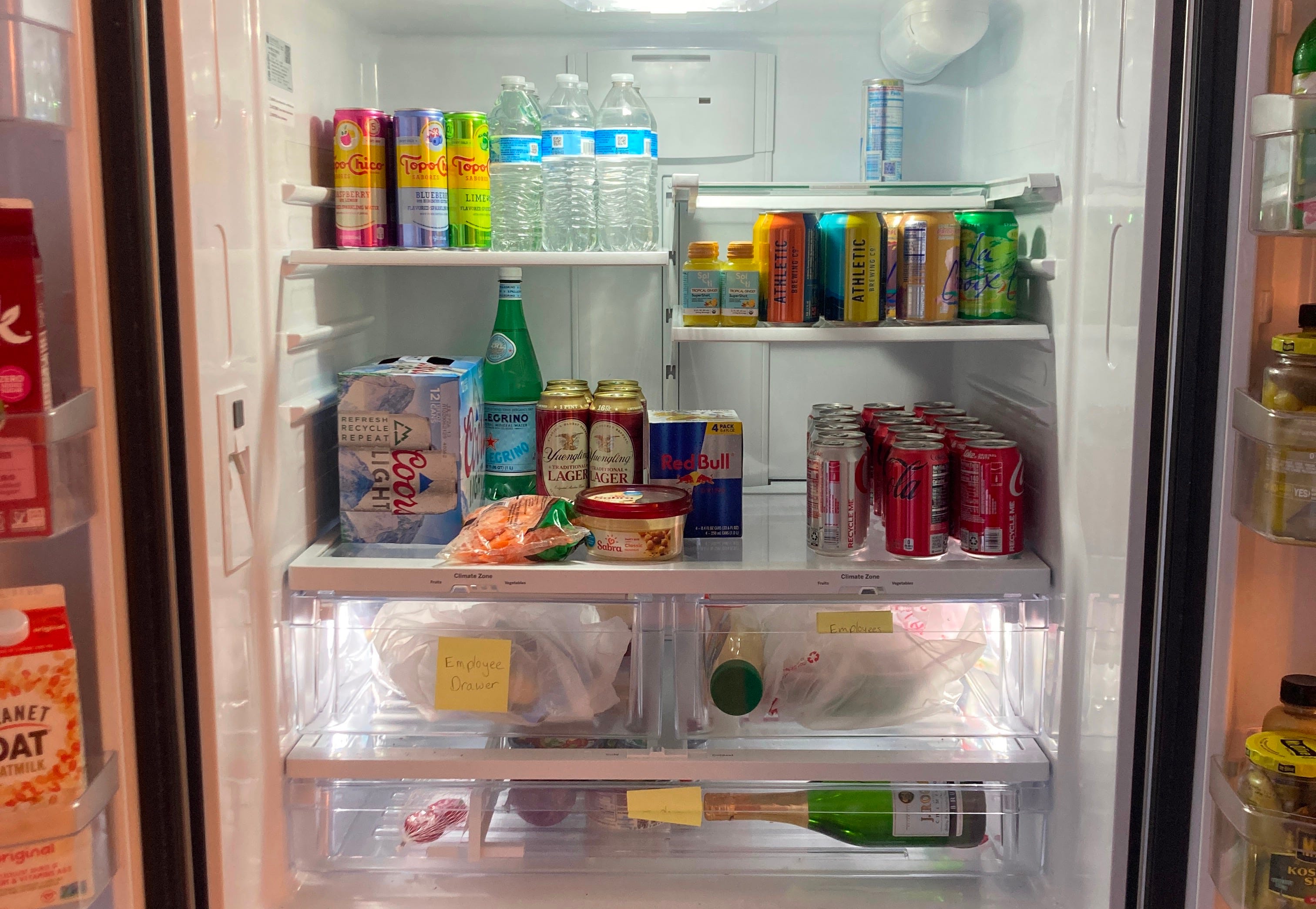
J: At the Elkton Music Hall. I got to say, most, you know, because I am touring at the level I’m touring at, I can’t really ask for these things because I’m not really selling out these bigger venues. And, you know, when you sell out a bigger venue, I think they do tend to sort of perk up and look at your rider. / But the way that I tour -
M: Hm. And beyond.
J: - and beyond. The way that I tour, it rarely gets fulfilled. We’re lucky if we get to a venue and they’ve even read the rider.
M: Well, what a thrill! / Surprise! Live for the surprise.
J: Hey, but every now and then, oh my god, every now and then I show up / and there is a twelver of Miller -
M: Also you, I’m sure you remember which, which venues fulfill the rider and which ones are like, This guy…
J: You do, yeah. You remember the ones that fulfill them, / because there’s only been a few.
M: I mean, that’s like when I’m on a film set and the food sucks -
J: Yeah. / Right, yeah.
M: - they don’t care about people. / The food is the most important thing.
J: They don’t want people to have a good time.
M: The thing that sustains life? / Food, shelter -
J: Makes a big difference. / Yeah.
M: - if there’s water readily available. If you’re not thinking about those things, you are not there for people.
J: Yeah.
M: Granted, you don’t need Espolòn to live.
J: You don’t, no.
M: You don’t.
J: I don’t, no, / thankfully.
M: Some people do.
J: Some people do and that’s a shame.
M: And you’re not there yet. / But we’re working on it.
J: Not yet. Not yet / but -
M: If you -
J: My essential tremors have nothing to do with alcohol.
M: Not a thing. If you were a more successful musician -
J: Yeah.
M: Who was, you know, garnering that kind of audience, what would you add to your rider?
J: Add to the rider. Oh man, I don’t know. I’m a very low-key person. I feel like I don’t need a lot. Like, I can’t imagine what I would really need that, you know… Champagne? Like a nice bottle of champagne?
M: You love champagne. / That’s not great for your voice though.
J: Chips and guac?
M: Gua-a-ac! Yes, guac is a step up above hummus.
J: Chips and guac.
M: For sure. You can be specific about the brand. Organic avocados only.
J: Yeah.
M: Siete chips / only.
J: Yeah, those are good. / Late July.
M: Ramblers only.
J: Ram - you know, Ramblers -
M: Fly it in if you have to. / Don’t though, ‘cause that’s a waste.
J: Rambler Seltzer would be a big one. Yeah. But I’m also, you know, you’ve taught me a lot about this, Mitz, is that touring can be really difficult because, you know, you try to be like, uh, like as close to like zero waste as possible. And what can be difficult about the rider is like, sometimes you end up with stuff you don’t need and then you’re like, throwing things away and trying to recycle things. So I’m always like, I don’t want more than we need.
Ugh, I love that so much.
M: I love that so much. And that’s literally what my next / question was gonna be.
J: What was it gonna be?
Q9: It’s I understand you’ve become a small-scale environmentalist in recent years. Johnny got a kick out of my use of “small scale” here, which made me think, hm, wrong term to use? Best to just keep going. How do you find that aligning with your experience touring, both in terms of the ethics of your band and venues? / And how can we all do better?
J: I mean - Well, you know, I’m not entirely vegetarian, but I’ve been really skewing vegetarian for the last two-and-a-half years. We have a vegan in the band and so / I, y’know -
M: Shout out Oscar.
J: Shout out to Oscar Rodriguez. I think we’re all a pretty mindful group more or less. On this tour - in the last two years of touring, I don’t think I’ve opened a single plastic water bottle.
!!!
M: That is so sexy.
J: It’s tough because that’s often what’s in the / green room -
M: Yeah, / I see them.
J: - you know, as you just learned. It still / is like an unfortunate thing.
M: And those little guys.
J: I know, and the / little ones.
M: Cancel those.
J: I just don’t do them anymore.
M: Yeah.
J: I don’t go near them. I bring a water bottle, try to find a source to refill it. If I can’t find it at the venue, I’ll try to find it. And often it’s funny, like, I’ll go to the bar and be like, “Hey, with the soda gun, can you just -
M: (fussing over his hair, which is standing up in a way he probably won’t like later, or I won’t like) I got you.
J: “Can you fill this up?” And they’ll be like, “Oh, there should be like, a, uh, waters in the green room.” And I’m like, “Yeah, can you just fill this up for me?” It’s not like - / I don’t want it. I’m trying to avoid those.
M: Yeah. yeah.
J: I don’t wanna dip into it.
M: It’s such a foreign concept to people, and I can’t, you know, I don’t blame them / for not -
J: Still a lotta -
M: - thinking about it, ‘cause I didn’t think about it for a really long time.
J: Still a lot of plastic cups.
M: Yeah.
J: That’s a tough thing with rock venues, obviously, because you wanna be safe. So I think they don’t want bottles or / glassware -
M: Glass - yeah.
J: - because you drop one, and - so I get it. Um, but I love, like, a draft beer, and then the one drag is that at a lot of these venues, you’ll go to get a draft beer, and it’ll be in a plastic cup, so I’m trying to avoid -
M: You know what I’m really into is aluminum cups that are / reusable. Those are sick. And also just, recyclable.
J: Yes. Next time, next time I go on tour I’m gonna bring some of those.
M: Yeah.
J: And I’m gonna be that annoying guy that goes to the bar and is like -
M: Be that annoying guy.
J: “Can you just fill this up with beer for me? / It’s exactly 10 ounces -
M: It’s necessary.
J: - “you can charge me the same thing.”
M: Yeah, like, what majority of the venues were even remotely mindful of their waste?
J: It seems like some of them -
M: Yeah?
J: You know, I feel like some, some of the theaters. I mean, when you’re playing sort of like, rock clubs, I think they’re doing their best. I mean, everybody’s sort of just trying to get by these days -
M: Mhm.
J: - and so it might not reflect entirely on their values, they might be trying -
M: And just certain cities also don’t have recycling programs / so like, what do you do.
J: It’s true. Our, our, our, you know, our, yeah.
Johnny’s gonna hate this one. This sentence. But it’s how people talk. And I love that about it.
M: Yeah. And definitely not composting programs, so.
J: But yeah, it’s something that I was not mindful of in the last - uh, like, like, about ten years ago. But you really opened my eyes to a lot of, a lot of my own inner hypocrisy about the way that I was sort of… that my behavior was not totally matching like my, my ethics. There’s obviously - / can be a chasm.
M: They call it “integrity.”
J: Well there’s, there can be a real chasm between what you believe and then your actions day to day.
M: Sure.
J: And I really started to realize that I couldn’t -
M: Divorce those things…
J: I couldn’t divorce those things anymore. I sort of was like, well, I’m gonna have to do one or the other, you know.
M: It’s been a beautiful thing to see. This guy became vegetarian, like, immediately upon meeting me. It was the most wonderful thing.
A knowing laugh. His humility. Like he’s aware of his humility, the size of his sacrifice.
M: No one can expect this to happen. I did not enforce it.
J: It started small. It was like, I just, we would go out on dates and I would be like, wow, this is where I would normally get the like Bolognese or I would get a burger or a steak. And I just was like, I don’t wanna do it in front of her. And then it just sort of stuck. And then I was like, wow, I - vegetables, I forgot, I didn’t realize how good they were.
M: And it was also a great weight loss mechanism.
J: Incredible. I packed a few on since then. But summer of 2024, wow. Thanks / for that.
M: Yeah, just disappeared.
J: Yeah.
M: Not that - that’s good. We shouldn’t disappear, but -
J: No.
This delivery kills me.
J: We should stay. We should appear.
M: We should stay, and hold space, and take it up.
J: Yeah.
M: We’re at my final question -
J: Ok, great.
How cordial, I think. Is he like this will all the interviewers?
M: - which really breaks my heart -
J: Oh man. Yeah.
M: - but we do have a friend coming over in about 15 minutes.
J: That’s true, yeah, we gotta watch Game Two of the NBA final.
Hold your thoughts, please. We hadn’t seen Game Five yet. Much less seen the Brooklynites pumping their fists on the roofs of the local buses.
J: I don’t know that I’ve been giving you good enough material.
M: You look great / and that’s -
J: I’ve been kind of nervous.
M: We can redo this / anytime -
J: Yeah.
M: You’re gonna be my only interview subject -
J: Great.
M: - and, uhh, we’ll become the talk of the town.
J: Sick.
Q10: In your wildest imagination, what is a music career you could die proud of?
J: Um, I have to dig deep for this because I have to say like, my own - like, that, you know, I have to -
M: Yeah.
J: I’ve been really trying to get to this place of being like, you know, what if I never can really tour the way I wanna tour, or if I never get on a talk show, if I never do a Tiny Desk, if I never hit these sort of like, bullet points that you’re supposed to hit to be like, they’ve made it in the music business. It doesn’t have to like, grow and be like a through-the-roof thing, but just some sustainability, I think. Just like, you know, have a / fanbase -
M: Not losing money -
J: And - and honestly not lose money. You know, I lost so much / money on this last tour and will continue to do so -
M: Yeah. But will you be thinking about that at the end of your life?
J: Probably not. You know, I’m a firm believer in, you know, you can’t take it with you.
Chills. I came across video footage of a lecture my dad gave at the grad school he taught at as I was collecting material to build his Celebration of Life video in which I met a new man, a dad I never met, uttering those words. “You can’t take it with you.”
M: Yeah. When you’re on your deathbed - and you spent years on your deathbed, remember?
J: Yeah. What, you mean in Swept Away?
M: That’s right.
J: Yes.
This is the pinnacle of his humor, I think, this kind of wistful, unequivocal surrender to something that doesn’t require or deserve it. Does he know it? He might. He’s very good at what he does, has been doing it a long time.
J: Um, no, I, I, I think just like, you know, records that I’m proud of, playing some shows, getting out there. It’s really all about just having the conversation. Singing songs, interacting with an audience, sharing them with people. You know, if I can just stay on like, a little bit of a path of just getting a few more people each year to listen, a few more people coming to shows, sharing something through the music. If that’s something that I can sustain, then, you know, I’ll be very proud, very happy.
M: A reciprocal energy -
J: Yeah.
M: - between yourself, your story and your listeners’ -
J: Yeah.
M: - experience.
What am I even saying? These are not my words, I renounce ownership.
J: Then to just play the Bowery Ballroom once / you know.
M: You will achieve this.
J: Well - we’ll see.
M: Let’s all put that energy into the atmosphere.
J: Yeah.
M: That’s it, that - those are all of my questions. Do you have questions? Of yourself?
J: Yeah, so many every day, but I’ve barely - I was -
M: We’ll get to those next / time maybe.
J: I’m tongue tied, I couldn’t even answer the ones you asked me.
M: Let’s see your tongue. It’s a nice tongue. It’s a very handsome tongue. It’s shapely, good color.
J: I think it’s time to end the interview.
M: Thank you so much for your time, / my love.
J: Hey, thank you for yours. I really appreciate it. Appreciate you guys.
M: Appreciate you guys. Love you so much -
J: Love you darling -
M: - love your love, / love your music -
J: - thanks for the questions. Oh, thank you.
M: - thanks for letting me contribute to your art.
J: Appreciate you waiting and waiting - and it is W-A-D-I-N-G, folks, it’s wading and wading. I didn’t print lyrics for the liner notes / this time around.
M: [lovely but unintelligible mumbled-incantation singing…] to the river to pray…
J: That’s not my song, and again / that might be in the public -
M: Wading??!
J: Um, / records, but -
M: (singing, lovelier still, invested) Let’s go down, let’s go down, / down to the river to pray…
J: You might get in trouble.
M: I’m not singing / any of the words.
J: You only have to do, what? Thirteen seconds of the song / in case of copyright infringement.
M: I think it’s about that, but / all of the lyrics were wrong.
J: That might be public domain. That’s, like, a classical… you know. That’s a hymn.
M: From the bibble?
J: It’s from the bibble. All right. Well, thanks, everyone!
M: (peaking her audio, dangerously, the confidence) Give us a wave.
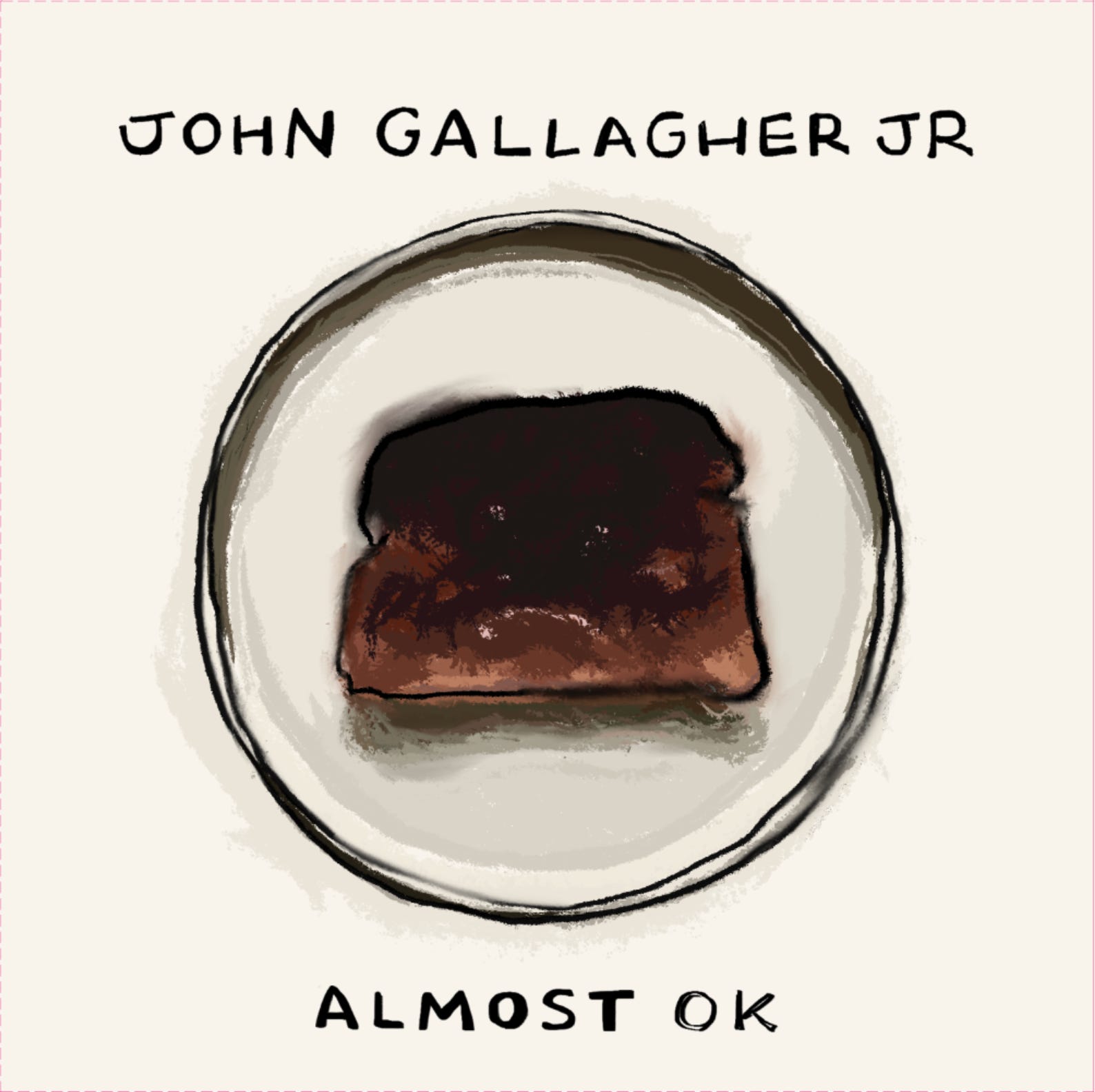
The familiar croon of a lover to his love, going Ohhhh, the heads a-twirling, one sock in the dryer, then its match. John smile-maxxes. He’s done this before. The album cover, my gift to Johnny in exchange for a month of free rent, skitters across the screen - it has a life of its own now.
J: Oh my god. How do you feel about…?